What a roll label says
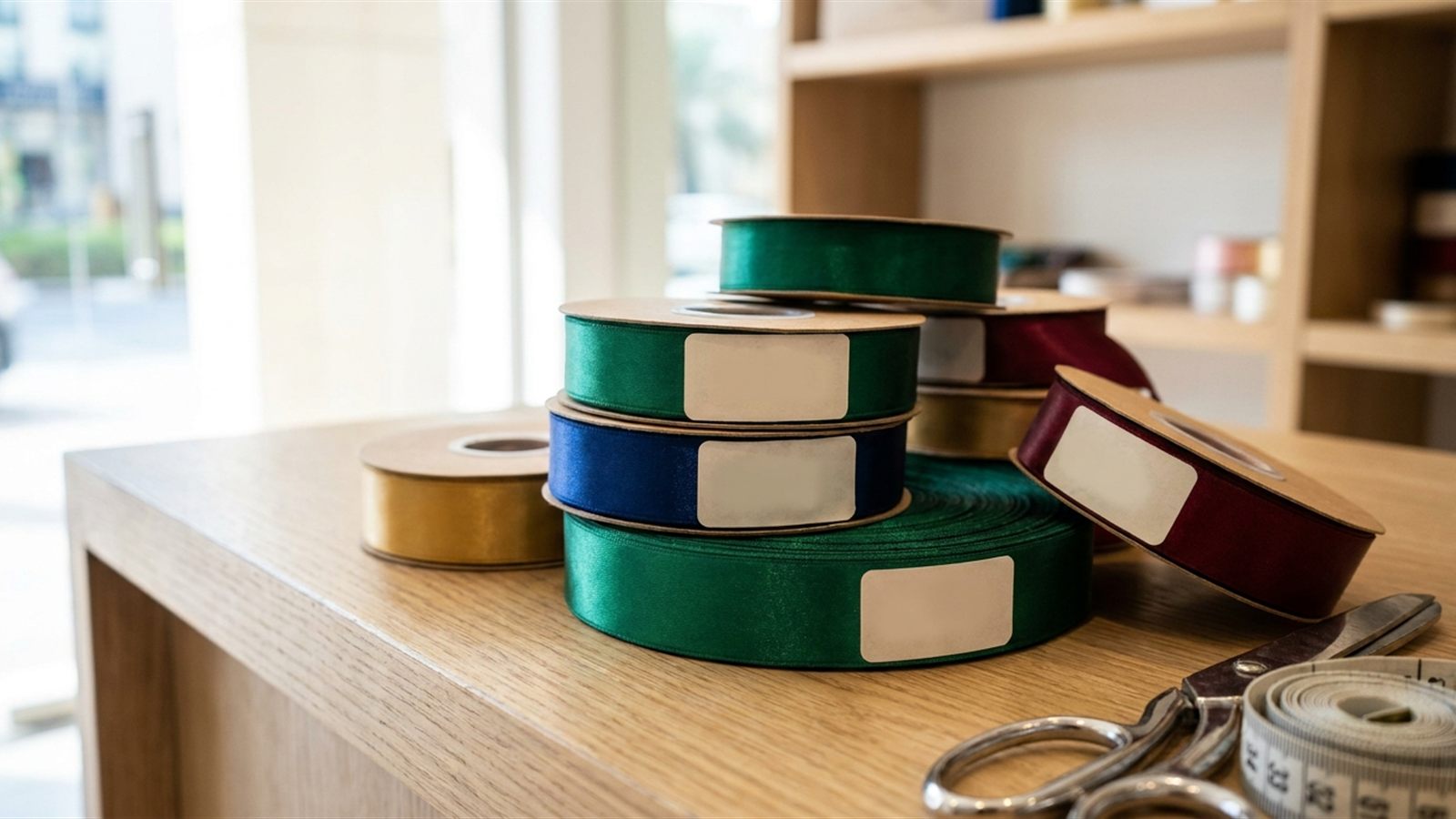
Every roll should carry a label on its core or a sticker on the wrap. The layout differs from one supplier to the next, but the same five facts appear on nearly all of them:
- Width. Usually in millimetres, sometimes in inches, sometimes both. This is the width of the ribbon itself, not the roll.
- Length. The number of units on the roll, such as 50 or 100.
- Unit. Yards (yd) or metres (m). It is often printed small, or abbreviated, so look for it deliberately.
- Material. Satin, grosgrain, organza and so on, sometimes with whether it is single-face or double-face.
- Colour. A name, a number, or both. The number is the one to quote when you reorder, because names are not standard across suppliers.
If any of these is missing from a quote, ask before you order. A roll described only as "satin, 25 mm, 50" has not told you the unit, and that single missing word changes the length by almost 4.3 m.
Yards and metres
One yard is 0.9144 m. So a 50 yd roll is 50 × 0.9144 = 45.72 m, which is about 9% less than a 50 m roll. Ribbon is sold both ways. Many satin and grosgrain rolls come in yards, usually in lengths of 25, 50 or 100 yd, while other ribbons are sold in metres. Neither is better; the point is to know which one you are looking at.
Comparing two quotes that look alike
Quotes often differ in ways that are easy to miss because the numbers look the same. Before you decide which is better value, put them on a common footing:
- Convert everything to metres. Multiply yards by 0.9144. Do this for the length on every roll, not just the headline roll.
- Find the total length offered. Rolls multiplied by length per roll. Two quotes for "10 rolls" are not the same if one is 10 × 50 yd (457.2 m) and the other is 10 × 50 m (500 m).
- Match the material and the face. Single-face and double-face satin are different products, even at the same width and length.
- Ask for the colour number. A shared colour name does not guarantee the same shade.
The fastest check is to write both quotes as total metres. If the totals differ, the unit is probably why, and the cheaper-looking quote may simply be the shorter roll.
Per roll and per metre pricing
Suppliers describe cost in two main ways, and it is worth knowing which one you are being given.
Per roll means a single figure for the whole roll, whatever its length. It is simple to read, but it only compares fairly between quotes if the rolls are the same length in the same unit. A per-roll figure for 50 yd and a per-roll figure for 50 m are not like for like.
Per metre (or per yard) means the figure is for each unit of length, and the roll price follows from the roll length. This makes comparison easier, provided both quotes use the same unit. If one is per yard and the other per metre, convert one of them before you compare.
Width in millimetres and inches
Width is the other number that appears in two systems. As a working rule, 25 mm is about 1 inch (precisely 25.4 mm), so 38 mm is about 1.5 inches and 16 mm is about 5/8 inch. For a bulk order, ask for the width in millimetres, since that is how it is measured and how it will be checked on delivery. The ribbon width guide explains which widths suit which box sizes.
Common roll lengths in metres
These are the yard lengths you will meet most often, with their metric equivalents:
| Roll length | In metres | Against a round metric roll |
|---|---|---|
| 25 yd | 22.86 m | About 9% less than 25 m |
| 50 yd | 45.72 m | About 9% less than 50 m |
| 100 yd | 91.44 m | About 9% less than 100 m |
Putting it together with the calculator
Once you know the roll length in metres, the rest is arithmetic. The ribbon calculator works out the ribbon per box, multiplies by the number of boxes, adds spare and divides by the roll length, rounding up. As a rule of thumb, add 5% spare for a team wrapping by hand, and more for a new style or a wide ribbon. The calculator shows its working, so you can check it against one box on your table.
A worked example for 300 boxes
Take the same box as the calculator page: 25 × 20 × 8 cm, cross wrap, with a 50 cm bow. That is 172 cm per box.
- Total ribbon: 172 cm × 300 boxes = 516 m.
- Plus 5% spare: 516 × 1.05 = 541.8 m.
- On 50 yd rolls (45.72 m): 541.8 ÷ 45.72 = 11.85, so 12 rolls.
- On 100 yd rolls (91.44 m): 541.8 ÷ 91.44 = 5.93, so 6 rolls.
- On 50 m rolls: 541.8 ÷ 50 = 10.84, so 11 rolls.
The same job needs 12 rolls in one unit and 11 in the other. Count the rolls only after you have converted the length to metres. Twelve 50 yd rolls give 548.64 m, a thin margin over 541.8 m, so ask for the extra roll in the same batch rather than topping up later. The dye lots guide explains why a top-up from a later batch may not match.
Questions buyers ask
How many metres are in a 50 yard roll of ribbon?
A 50 yd roll holds 45.72 m, because one yard is 0.9144 m. That is about 9% less than a roll of 50 m. Always read the unit on the label before comparing it with a metric roll.
Is a yard longer or shorter than a metre?
A yard is shorter. One yard is 0.9144 m, or about 91 cm. That is why a roll described as 100 yd holds 91.44 m and not 100 m.
How do I compare two ribbon quotes with different units?
Convert both to metres, multiply by the number of rolls to get the total length, and compare like for like. If one quote is in yards, multiply by 0.9144. Check the width, material and face as well, because a match in length alone does not make two rolls the same product.
Is 25 mm ribbon the same as 1 inch ribbon?
Close enough for practical use. One inch is 25.4 mm, so a 25 mm ribbon and a 1 inch ribbon look identical on a box. For a bulk order, ask for the width in millimetres so there is no doubt. The ribbon width guide lists the common sizes.
How much spare ribbon should I add to the total?
A sensible floor is 5% for a team wrapping by hand. Add more for a new style, a new team, or a wide ribbon that shows every mistake. The ribbon calculator lets you set the spare yourself and shows the effect on the roll count.