The three ways Arabic goes wrong
Almost every problem with Arabic on printed ribbon falls into one of three faults, and all three show up in the artwork file rather than at the press.
- Letters disconnected. Arabic letters change shape depending on where they sit in a word and join to the letters beside them. When the design software does not shape Arabic correctly, the letters print as separate, isolated forms instead of a joined word, and a fluent reader sees it immediately as wrong.
- Text reversed. Arabic reads right to left. Software built around left-to-right text can lay the characters out in the wrong order, so the word prints back to front even though each letter looks fine on its own.
- Wrong or missing dots and diacritics. Many Arabic letters are distinguished only by the number and position of small dots, and some words carry marks above or below the letter that change how it is read. These are easy to drop, substitute or misplace, and the change can alter the word completely.
Why it happens
All three faults trace back to the same handful of causes. Design software without proper Arabic shaping support will not join letters correctly, however the text was typed. Copying Arabic text between applications, especially from a chat message, a spreadsheet or a PDF, is a common point where direction and joining break, because the copy carries plain characters without the shaping information the original used. The most damaging version of the problem is converting the text to outlines before the rendering fault is corrected: once broken, disconnected or reversed letters are turned into outline shapes, the fault is locked into the artwork and will print exactly as it looks on screen, however carefully everything else is checked.
How to supply Arabic text safely
Two things should travel together for any Arabic line on ribbon:
- The artwork, as outlined vector, produced from software that shapes Arabic correctly in the first place, so the joins and direction are right before anything is converted to outlines. This follows the same rule as any other printed ribbon artwork, covered in the logo-printed ribbon guide and the guide to artwork files.
- The original text, in a separate plain text file, not inside the artwork. This gives the printer something to compare the outlined shapes against, word for word, and gives a native reader an easy way to check the wording without opening design software.
Sending only a picture of the words, or only the outlined vector with no plain text to check it against, removes the one thing that catches a reversed or disconnected word before it is cut into hundreds of metres of ribbon.
Direction on the ribbon
Arabic reads right to left. On a ribbon that runs along its length, this means the start of an Arabic greeting sits at the right-hand end of each repeat, with the text running back towards the left, the mirror of how an English line on the same ribbon would be set. Checking this on the finished artwork, not only on the text as typed, is part of the same check as disconnected letters: a layout that looks correct in a text box can still print back to front once it is placed on the ribbon's repeat.
Bilingual lines: English and Arabic together
Most buyers printing Arabic on ribbon in the UAE want it alongside English, not alone. Two layouts are common:
- Stacked, with the English line above or below the Arabic line, each set in its own correct direction.
- Mirrored either side of a mark, such as a small motif or a brand mark, with English reading outward to the left and Arabic reading outward to the right from the centre.
Whichever layout is chosen, the rule from the Ramadan and Eid ribbon guide applies: tie a bow from a proof print and check that at least one complete greeting, in both languages, shows on the front.
The greetings buyers print
This is an English-language page, so it describes rather than spells out the Arabic wording. The greetings UAE buyers most often print on ribbon are the Ramadan greeting ("Ramadan Kareem"), the Eid greeting ("Eid Mubarak"), and the UAE National Day greeting. The exact Arabic wording, spelling and letter forms for any of these must come from the brand itself, not be guessed from an English phrase, and must be checked by a native reader before the proof is approved. A greeting that is close but not quite right is still wrong, and ribbon that has already been printed cannot be corrected.
Calligraphic vs simple typefaces
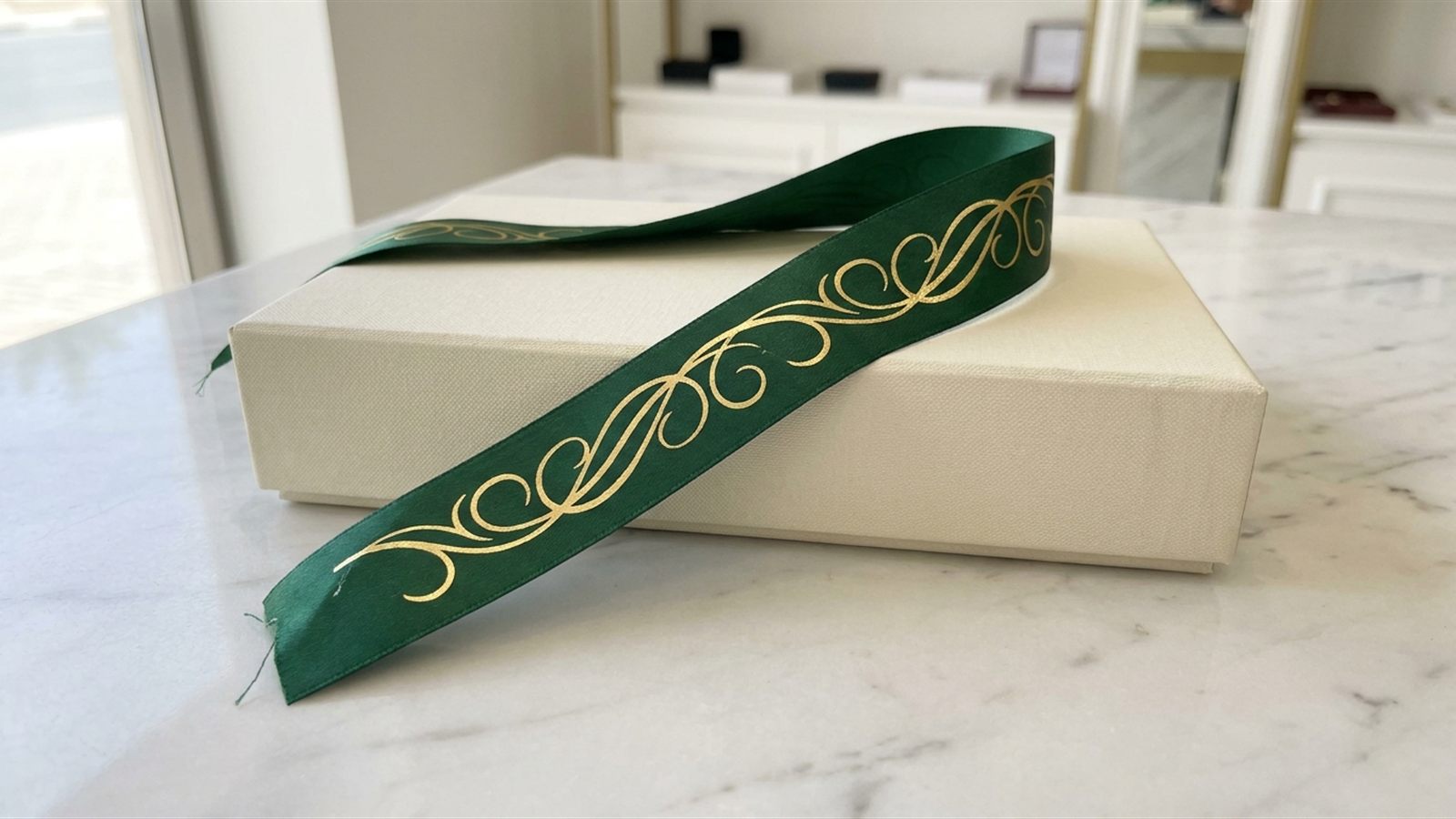
Arabic typefaces range from simple, geometric letterforms to flowing calligraphic styles with fine hairlines, long sweeping strokes and decorative flourishes. A calligraphic style can look striking in a proof on screen or paper, but ribbon is printed small and the ribbon's surface is not paper: fine hairlines and small diacritic marks can fill in or drop out entirely at typical ribbon widths, especially in foil or screen print. A simpler, more geometric typeface holds its shape far better at small sizes. As with English text, give the design room: the Ramadan and Eid ribbon guide notes that 25 mm and wider gives space for a clear line of text, while narrower ribbon should keep to a short word.
Who checks it
A native Arabic reader signs off the proof before printing, every time, including on a reorder of wording that has been printed before. A simple checklist before approval:
- The wording matches what the brand supplied, word for word, against the plain text file
- The letters join correctly and no letter prints as a disconnected, isolated form
- The direction is correct: the greeting starts at the right of the ribbon's repeat
- Every dot and diacritic is present and in the right place
- At small size, on the actual ribbon width and finish, the text is still legible, not filled in or broken up
- A bow tied from the proof shows a complete greeting on the front, in both languages if bilingual
None of these checks can be done reliably by someone who does not read Arabic, however careful they are. A font that looks elegant and a layout that looks balanced tell you nothing about whether the word is spelled correctly or facing the right way.
The short checklist
- Arabic text supplied as outlined vector, from software that shapes Arabic correctly
- The original text also sent as a separate plain text file, for comparison
- Direction checked on the final artwork: the greeting starts at the right
- Typeface chosen that holds its hairlines and dots at the ribbon's width
- Exact wording confirmed by the brand, not guessed from an English phrase
- Proof signed off by a native Arabic reader before the full run is printed
Questions buyers ask
Why do Arabic letters print disconnected on ribbon?
Disconnected letters happen when the design software used to set the text does not shape Arabic correctly, so each letter prints as an isolated form instead of joining to the letters beside it as Arabic normally does. This is a fault in the artwork file, not the printing process, and it is locked in permanently if the text is converted to outlines before it is corrected. Use software that shapes Arabic correctly and check the final file, not just the draft.
Which direction does Arabic run on a printed ribbon?
Arabic reads right to left, so on a ribbon running along its length the start of a greeting sits at the right-hand end of each repeat, with the text running back towards the left. This is the mirror of an English line on the same ribbon. Check the direction on the final artwork file, since a text box that looks correct on screen can still print back to front once it is placed on the ribbon's repeat.
What file should I send for Arabic text on printed ribbon?
Send the Arabic as outlined vector artwork, produced from software that shapes Arabic correctly, together with the original text in a separate plain text file. The plain text file gives the printer and a native reader something fixed to compare the outlined shapes against, word for word. Sending only a picture of the words, or outlines with no text to check them against, removes the one safeguard that catches a reversed or disconnected word.
Can I print Ramadan Kareem or Eid Mubarak in Arabic on ribbon?
Yes, and both are among the most commonly printed Arabic greetings on ribbon in the UAE, alongside the National Day greeting. The exact Arabic wording must come from the brand itself, not be guessed from the English phrase, and a native Arabic reader must check it before the proof is approved. The Ramadan and Eid ribbon guide covers the seasonal side of printing a greeting.
Does a calligraphic Arabic font work on narrow ribbon?
Often not as well as a simpler, more geometric typeface. Calligraphic styles carry fine hairlines and small decorative flourishes that can fill in or drop out at typical ribbon widths, especially in foil or screen print, even when the same design looks sharp on paper. A plainer letterform holds its shape far better at small size, and giving the design more width helps whichever style is chosen.
Who should check Arabic text before it is printed on ribbon?
A native Arabic reader, every time, including on a reorder of wording printed before. They should check the proof against the brand's own plain text wording, confirm the letters join correctly, confirm the direction is right, and confirm every dot and diacritic is present. No amount of care from someone who does not read Arabic can substitute for this, because a balanced, elegant-looking layout can still be spelled wrong or facing the wrong way.
Can English and Arabic sit on the same ribbon?
Yes, most buyers printing Arabic on ribbon in the UAE want it alongside English. The two common layouts are stacking the English line above or below the Arabic line, each set in its own correct direction, or mirroring them either side of a small mark, with English reading outward to the left and Arabic outward to the right. Tie a bow from the proof and check a complete greeting in both languages shows on the front.