Why ribbon frays
A roll of ribbon has two kinds of edge. The long edges, running the length of the roll, are woven or finished in manufacture and do not come apart. The two ends you create every time you cut are not finished at all: the cut exposes the threads that ran along the ribbon's length, and with nothing holding them in place, they work loose one by one.
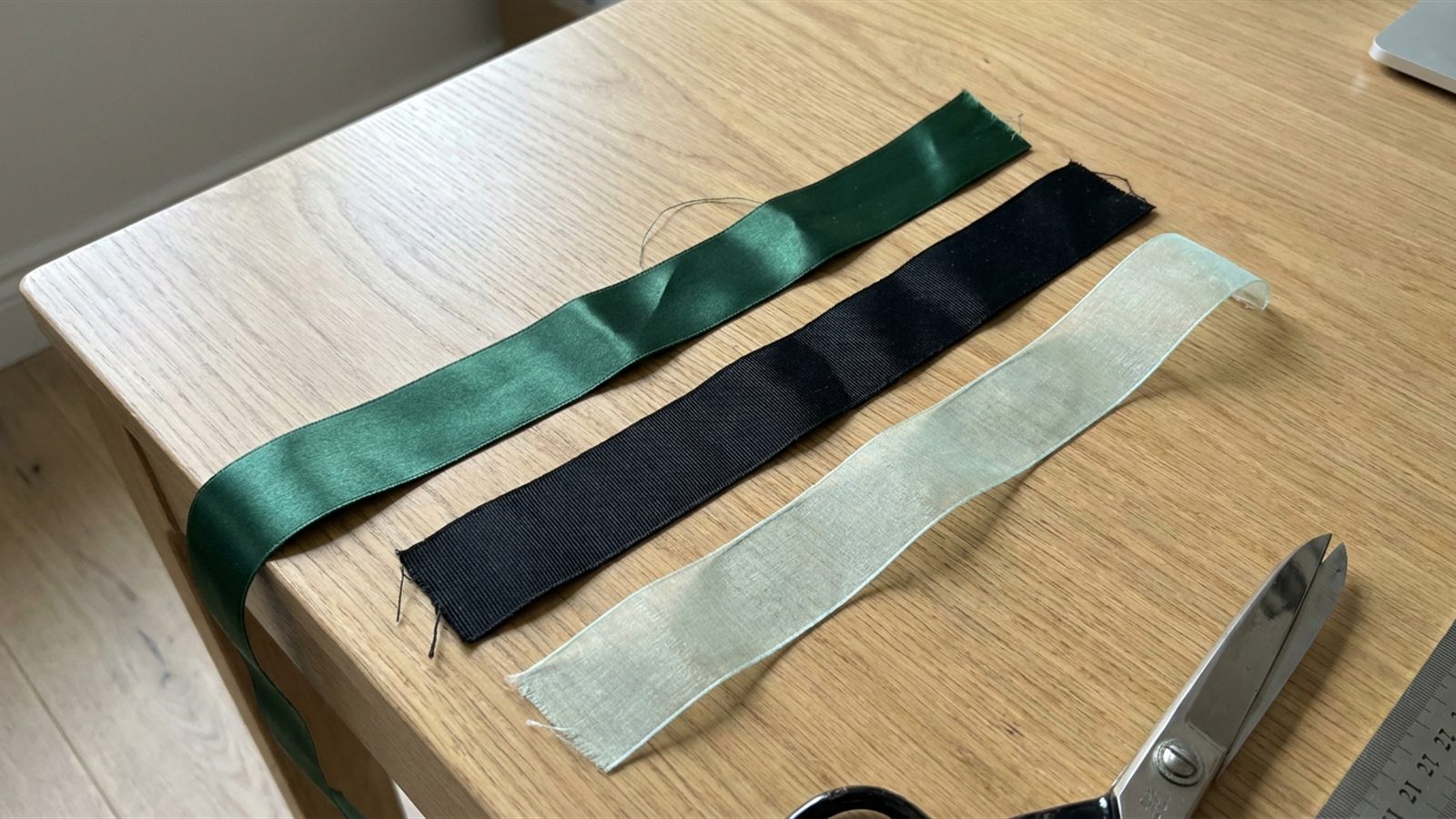
How fast that happens depends on the fibre. Polyester satin, grosgrain and organza are woven from a continuous man-made thread, which is what makes heat sealing possible: the cut threads melt back together under heat. Cotton ribbon frays in the same way a cut end of cotton fabric does, in loose loops rather than melting, and it cannot be heat sealed. Velvet's pile hides a little fraying at the base but still sheds from a straight cut over time. Paper ribbon does not fray in the usual sense; it tears or crushes at a straight cut instead, so the cuts below matter less to it than keeping the blade sharp.
The four cuts
All four start the same way: pull the ribbon taut between two fingers so it does not twist under the blade, and cut in one motion rather than sawing.
- Straight. A clean cut square across the ribbon. It fits flush against a box edge or a label, but it is the cut most likely to fray, so use it only where the end will be glued down, tucked under a knot, or heat sealed straight after.
- Angled or diagonal. A single cut across the ribbon at roughly 45 degrees. It sheds fewer threads than a straight cut, and it is the plain finish for a tail that hangs free on a bow. It is also the trim allowed for in the ribbon calculator's spare allowance, since every tail loses a little length to it.
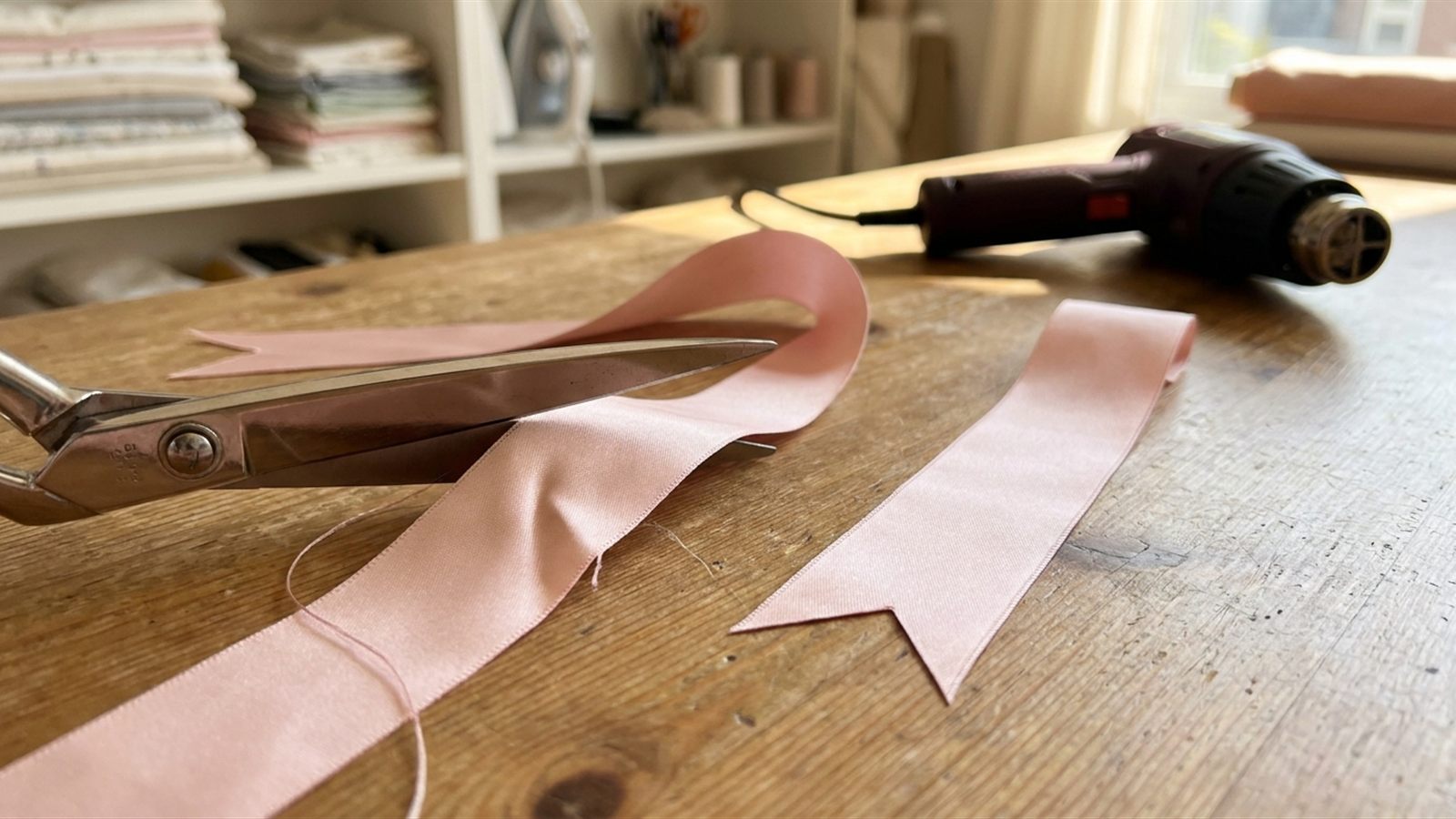
- V, or swallowtail. Fold the ribbon in half lengthways and cut from the fold outward at an angle, so the two tails come away with a notch between them. It looks more finished than a plain angle and suits a wider ribbon or a formal bow where the tails are the last thing the eye sees.
- Double angle. Two angled cuts meeting in a shallow point, rather than one straight diagonal. It reads as a sharper, narrower V and suits a narrow ribbon where a full swallowtail notch would look fussy.
None of the four stops a fray-prone fibre from fraying eventually; they only slow it. For a ribbon that will be handled a lot, pair the cut with heat sealing or fray-check liquid below.
Keep one pair for ribbon only
Use sharp fabric scissors kept for ribbon and nothing else. Cutting paper, card or wire with the same blades rolls the fine edge over in a way that is not visible to the eye but is obvious the next time you try to cut satin: the blades pinch and drag the threads instead of slicing them cleanly, which is its own cause of fraying, separate from the shape of the cut. A dull or paper-dulled blade also makes a ragged straight cut even when you meant to cut at an angle.
Heat sealing polyester ribbon
Heat sealing melts the cut end of a polyester ribbon just enough for the threads to fuse together, so nothing is left loose to pull apart. Pass the cut end near a small flame or a heat tool, close enough to feel the heat but not through it, for a second or two, tested on an offcut first. The edge should go slightly glossy and firm, not blackened or dripping.
It works on polyester satin, grosgrain and organza. It does not work on cotton, velvet or paper ribbon, which either scorch or simply do not have a thermoplastic thread to melt.
Safety. Test on an offcut first, every time you change ribbon, width or supplier. Work in a well-lit space away from the roll itself and anything else flammable. Never hold printed or metallic ribbon near a flame without testing it first: foil, metallic thread and some print coatings can scorch, smoke or flare differently from plain polyester.
If you would rather not use a flame at all, a fray-check liquid is the alternative: a small amount dabbed on the cut end, left to dry, stiffens the threads in place without heat. It works across more fibres than heat sealing does, including cotton, but it dries with a faint stiffness and a slight sheen, so test it on an offcut first too, especially on a pale colour.
Pinking shears, and wired edges
Pinking shears cut a small zigzag along the edge instead of a straight line. The zigzag is mostly decorative rather than a cure for fraying: it is popular on grosgrain and on ribbon that will not be heat sealed, giving a finished look to an edge that would otherwise fray in a straight line. It suits a craft or favour finish more than a formal bow.
Wired-edge ribbon, covered in the guide to velvet, metallic, wired and sheer ribbon, needs its own step at the cut end: after cutting, fold the short length of exposed wire back over itself rather than leaving it sticking out, so it cannot catch on a hand or a box. The wire can work loose at a cut end over time, so check it again before the ribbon is reused or re-tied.
Cutting many tails the same
When you are finishing a run of bows for the same order, consistency matters more than any single cut being perfect. Cut every tail in the batch first, in one pass, rather than cutting and tying one bow at a time; your eye and your hand drift over a long run, so a batch cut the same way stays more even than cuts made between other steps. For an angled or double-angle cut, a simple card template held against the ribbon gives every cut the same angle without measuring each one. Keep the template for the next order in the same width.
Which cut, and how it holds up
| Cut | Suits | Holds up to handling? |
|---|---|---|
| Straight | Ends that are glued, tucked or heat sealed straight after | Weak on its own; frays fastest |
| Angled or diagonal | Free-hanging tails, everyday bows | Fair; slows fraying, does not stop it |
| V (swallowtail) | Wider ribbon, formal bows | Fair, and looks finished longer |
| Double angle | Narrow ribbon | Fair, similar to a single angle |
| Heat sealed (polyester) | Satin, grosgrain, organza that will be handled a lot | Best; the edge no longer unravels |
| Pinking shears | Craft and favour finishes, decorative edges | Fair; mainly a look, not a seal |
The short checklist
- Scissors kept for ribbon only, never used on paper, card or wire
- Cut chosen for the job: angled or V for a tail that hangs free, straight only where the end is secured another way
- Polyester ribbon that will be handled a lot: heat sealed, tested on an offcut first
- Flame or heat tool kept away from printed and metallic ribbon unless tested
- Wired-edge ribbon: wire folded back at every cut end
- A batch of tails cut in one pass, with a card template for a repeated angle
Questions buyers ask
Why does ribbon fray after it is cut?
Because the long edges of a roll are finished in manufacture, but a cut end is not. The cut exposes the threads that ran along the ribbon's length, and with nothing holding them in place, they work loose one by one. How fast that happens depends on the fibre: polyester can be heat sealed shut, cotton frays in loose loops the way cut fabric does, and velvet sheds slowly from under its pile.
What is the best way to cut ribbon so it does not fray?
Cut at an angle rather than straight across, which is the plain everyday finish for a free-hanging tail, or cut a V (swallowtail) for a more finished look on wider ribbon. Neither cut stops fraying completely on its own; it only slows it. For a ribbon that will be handled a lot, pair the cut with heat sealing on polyester or a fray-check liquid.
How do you heat seal ribbon?
Pass the cut end near a small flame or heat tool, close enough to feel the heat but not through it, for a second or two, tested on an offcut first. The edge should go slightly glossy and firm, not blackened. It works on polyester satin, grosgrain and organza, which melt and fuse at the cut, but not on cotton, velvet or paper ribbon.
Is it safe to heat seal ribbon with a lighter?
It can be, with care. Test on an offcut first every time you change ribbon, width or supplier, work in a well-lit space away from the roll and anything flammable, and never hold printed or metallic ribbon near a flame without testing it, since foil and metallic thread can scorch or flare differently from plain polyester. A fray-check liquid avoids a flame altogether, at the cost of a faint stiffness on the cut end.
Can you heat seal cotton or velvet ribbon?
No. Heat sealing works by melting the cut threads of a polyester ribbon back together, and cotton and velvet do not have that thermoplastic thread to melt; they scorch or blacken instead. Cut cotton and velvet at an angle or in a V to slow fraying, or use a fray-check liquid, which works across more fibres than heat sealing does.
What do pinking shears do to ribbon?
Pinking shears cut a small zigzag along the edge instead of a straight line, giving a decorative, finished look rather than sealing the edge against fraying. They suit grosgrain and craft or favour finishes that will not be heat sealed. For a formal bow, an angled or V cut, paired with heat sealing on polyester, holds up better over time.
How do you finish the cut end of wired-edge ribbon?
Cut it the same way as the base ribbon, then fold the short length of exposed wire back over itself so it cannot catch on a hand or a box. The guide to velvet, metallic, wired and sheer ribbon notes that wire can work loose at a cut end over time, so check it again before the ribbon is reused or re-tied.