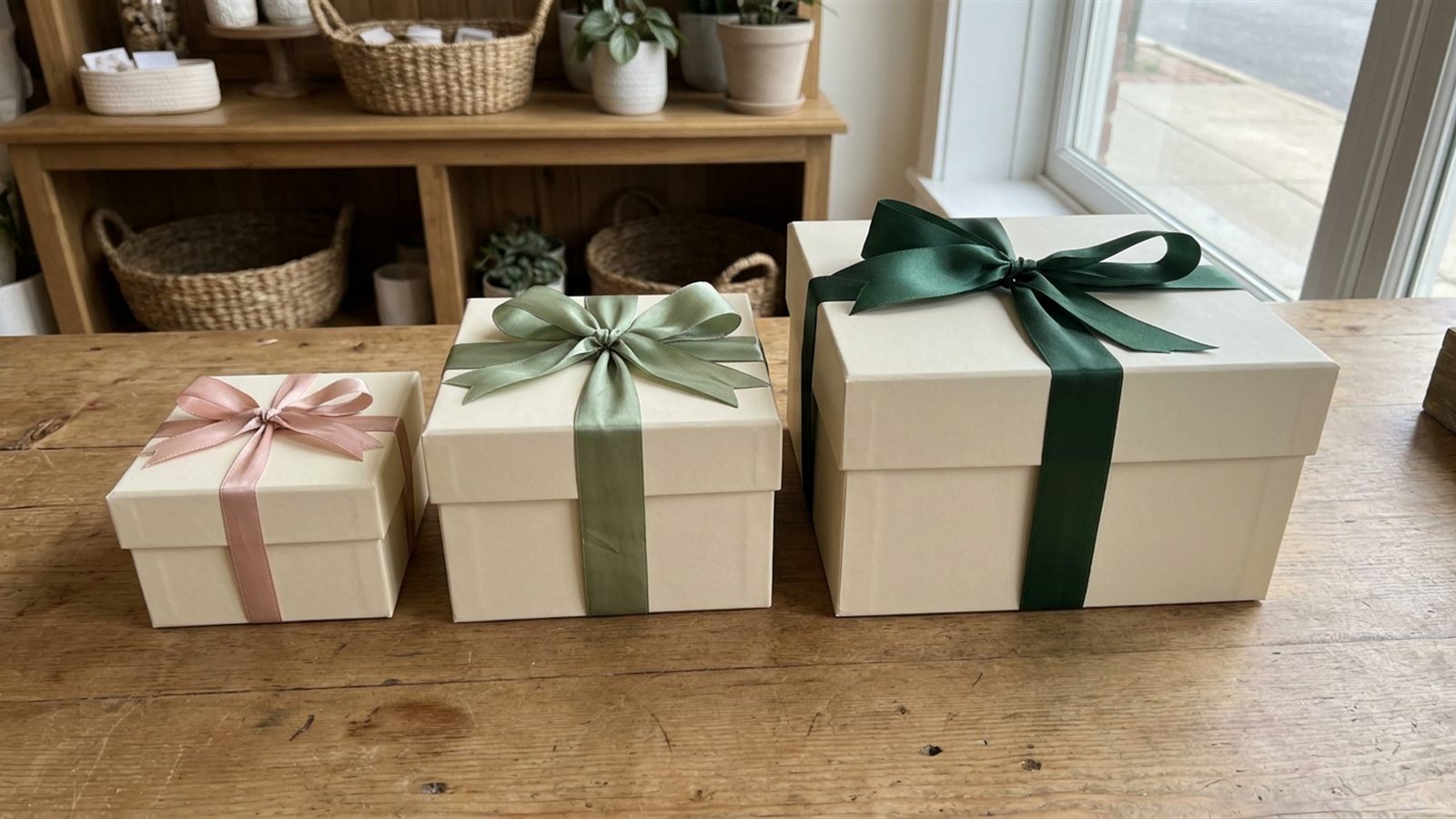
What decides a bow's size
Three things set how big a bow should be: the width of the box's lid, the width of the ribbon, and the style you tie. A flat two-loop bow, a full double-loop bow and a simple knot with tails all use different lengths of ribbon for the same box, before width even comes into it.
- Lid width sets the scale. A bow is sized against the shorter side of the lid, the same measurement the ribbon width guide uses to pick a width.
- Ribbon width changes the loops. Wider ribbon needs bigger loops to look right, so it takes more ribbon for the same box.
- Style changes the count. More loops and fuller tails simply use more ribbon than a flat bow or a plain knot.
The proportion rule of thumb
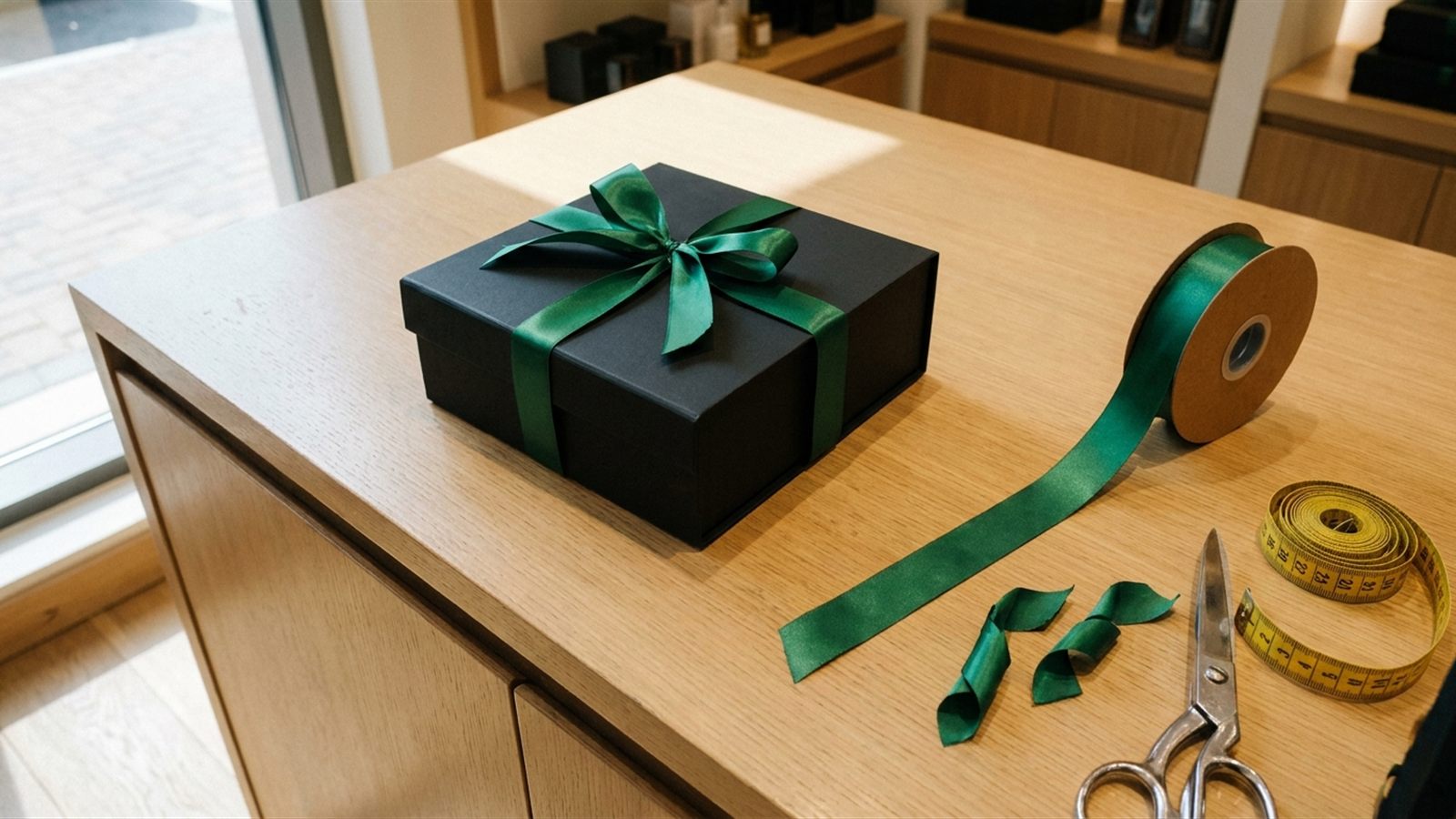
As a rule of thumb, not a standard, a bow that spans about a third to a half of the lid's shorter side looks balanced: smaller and it reads as an afterthought, bigger and it starts to compete with the box. A bow sitting on a 20 cm (about 8 in) lid, for example, looks right somewhere around 7 to 10 cm (about 2¾ to 4 in) across.
Ribbon width pushes on the same proportion. A wider ribbon needs proportionally bigger loops to hold its own shape, so the same bow-width target on the box takes more ribbon in 38 mm than it does in 16 mm. Use the width rule of thumb first – up to about 15 cm: 6 to 16 mm; about 15 to 30 cm: 16 to 25 mm; over 30 cm, and hampers: 38 to 50 mm – then size the bow to that width, not the other way round. The width lab lets you see a given width sitting on a box before you commit to it.
The arithmetic of one bow
A simple bow breaks into three parts: two loops, the wrap where they cross at the knot, and two tails. In words, the ribbon a bow takes is:
(2 × loop length) + knot wrap + (2 × tail length)
Loop length and tail length both grow with the ribbon's width and with the bow's target size on the box, which is why there is no single fixed figure for "a bow" – only a method for working one out for your own box and ribbon.
Worked example, medium box
Take a bow sized for a medium box, aimed at the proportion rule above, tied in a mid-range width. Loops and tails come out roughly even with each other once the bow looks balanced, so the sum of two loops, the wrap and two tails on a bow like this lands inside the ribbon calculator's stated range: a simple bow with two loops and two tails on a medium box usually takes somewhere between 40 and 60 cm (about 16 to 24 in). A full double-loop bow on the same box sits towards the top of that range or a little past it, because it repeats the loop step; a plain knot with tails and no loops sits well below it, because there is no loop length to add at all.
Three styles, compared
| Style | Loops | Ribbon used |
|---|---|---|
| Flat, two-loop bow | 2 | Towards the lower half of the calculator's 40 to 60 cm range for a medium box, more at wider widths |
| Full, double-loop bow | 4 (two pairs) | Towards the upper half of the range, or a little over it, because the loop step repeats |
| Knot and tails, no loops | 0 | Well under the range, since only the wrap and the tails are left |
These are positions within the calculator's range, not new numbers of their own. Measure your own bow in each style before you order, as the next section covers.
Too big, and too small
A bow that is too big for its box hides the box itself, catches on the edge of a gift bag or a car door, and – at the wider widths, without wire in the ribbon – flops rather than holding its loops open. A bow that is too small reads as string: it disappears against the box and does not do the one job a bow has, which is to draw the eye.
Wider ribbon without wire holds a smaller bow well but struggles to hold a big one open. If you want a large bow in 38 or 50 mm ribbon, use a wired ribbon or expect to dress the loops by hand after tying.
How to measure your own bow in two minutes
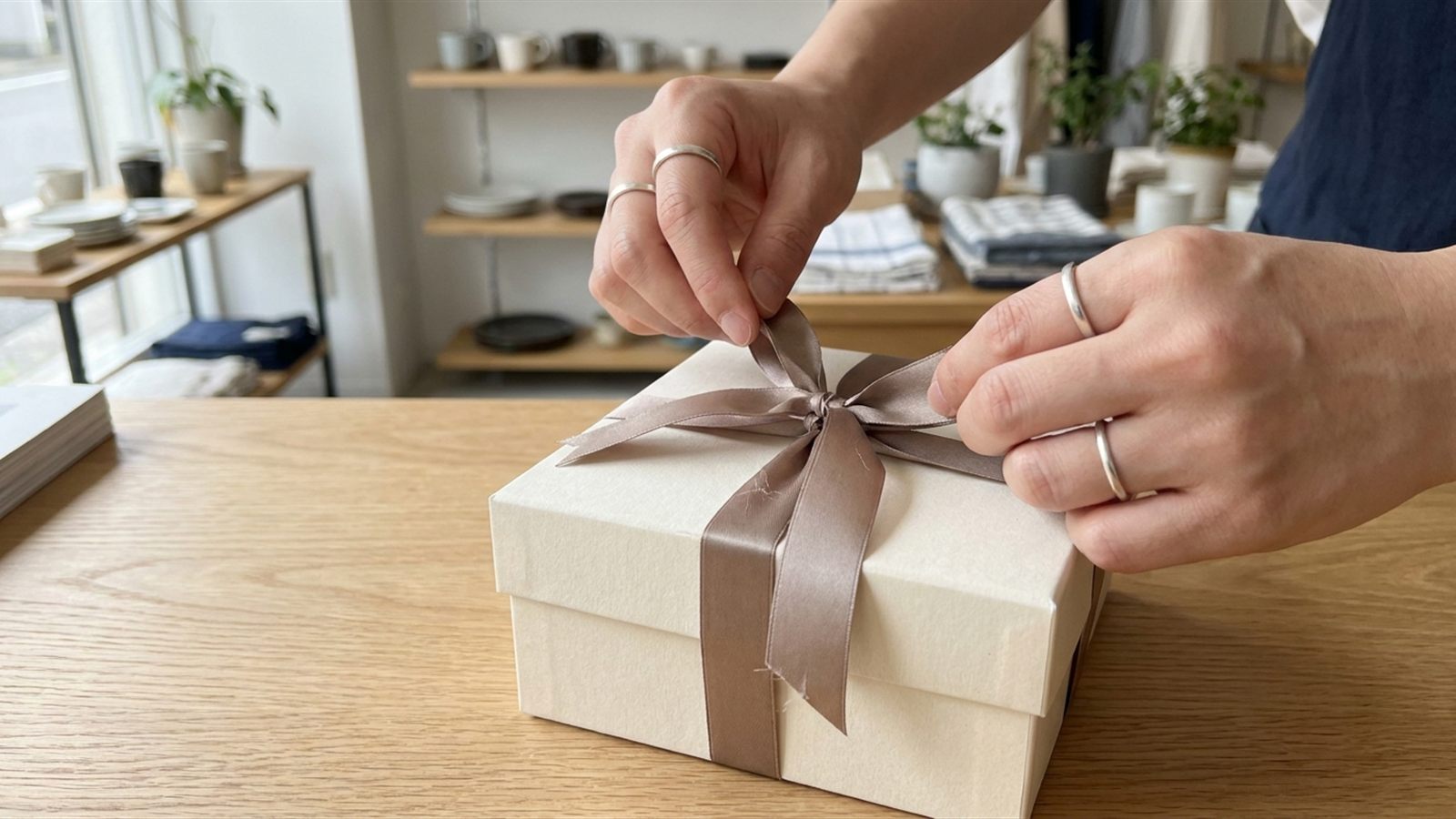
Tie a single bow the way you will tie all of them, in the style, width and ribbon you will actually use, sized to the proportion that looks right on your box. Untie it and measure the ribbon. That figure, not a number from this page, is the one to use. This is the same measure described in the ribbon calculator: measure one, then order. If you have not yet tied one, the guide to tying a neat gift bow walks through the steps.
Ordering: the bow allowance in the total
Once you have your own figure, it slots straight into the calculator as the bow allowance: multiply it by the number of boxes, add the band around each box, then add a 5% spare for lopsided bows and angled trims. The ribbon calculator does all of that arithmetic and rounds up to whole rolls once you enter your measured bow length.
The short checklist
- Width chosen from the box's shorter side, using the rule of thumb or the width lab
- Bow style decided: flat, full, or knot and tails
- Target bow size set at about a third to a half of the lid's shorter side
- One bow tied, untied and measured in that width and style
- Measured figure entered as the bow allowance in the ribbon calculator, with 5% spare added
Questions buyers ask
How much ribbon does a bow use at different widths?
Width does not change the formula, only the size of the loops: two loops plus the knot wrap plus two tails. A simple bow with two loops and two tails on a medium box usually takes somewhere between 40 and 60 cm, and wider ribbon needs bigger loops to look right, so it sits towards the top of that range rather than a fixed number. Tie one bow in your own ribbon and measure it rather than guessing.
How big should a bow be for the box it sits on?
As a rule of thumb, a bow about a third to a half of the lid's shorter side looks balanced. On a 20 cm lid that is roughly 7 to 10 cm across. Go smaller and the bow reads as an afterthought; go bigger and it starts to compete with the box rather than sit on it.
Does a wider ribbon need a bigger bow?
Yes. A wider ribbon needs proportionally bigger loops to hold its shape and look right, so the same target size on the box takes more ribbon once you move up a width. If you move from 16 mm to 38 mm, tie a new sample bow and measure it again rather than reusing the old figure.
What is the difference between a flat bow, a full bow and a knot with tails?
A flat, two-loop bow is the simplest shape and sits towards the lower half of the usual 40 to 60 cm range for a medium box. A full, double-loop bow repeats the loop step and sits towards the upper half of that range or a little over it. A knot with tails and no loops at all uses well under the range, since it is only the wrap and the tails.
Why does my bow flop instead of holding its shape?
Wide ribbon without wire struggles to hold a large bow's loops open, so it flops rather than standing up. It is a sign the bow is too big for the ribbon's body, not that the ribbon is faulty. Either use a wired ribbon for a large bow in 38 or 50 mm, or dress the loops by hand once it is tied.
How do I work out my own bow allowance?
Tie a single bow the way you will tie all of them, in the width and style you will use, sized to look right on your box. Untie it and measure the ribbon: that figure is your bow allowance. Enter it in the ribbon calculator, which multiplies it by your box count and adds a 5% spare.
What size bow looks too small for a gift box?
A bow well under about a third of the lid's shorter side tends to read as string rather than a bow, because it disappears against the box instead of drawing the eye. This is the same proportion problem as a bow that is too big, just in the other direction. Measure against the box itself, not against a fixed centimetre figure.