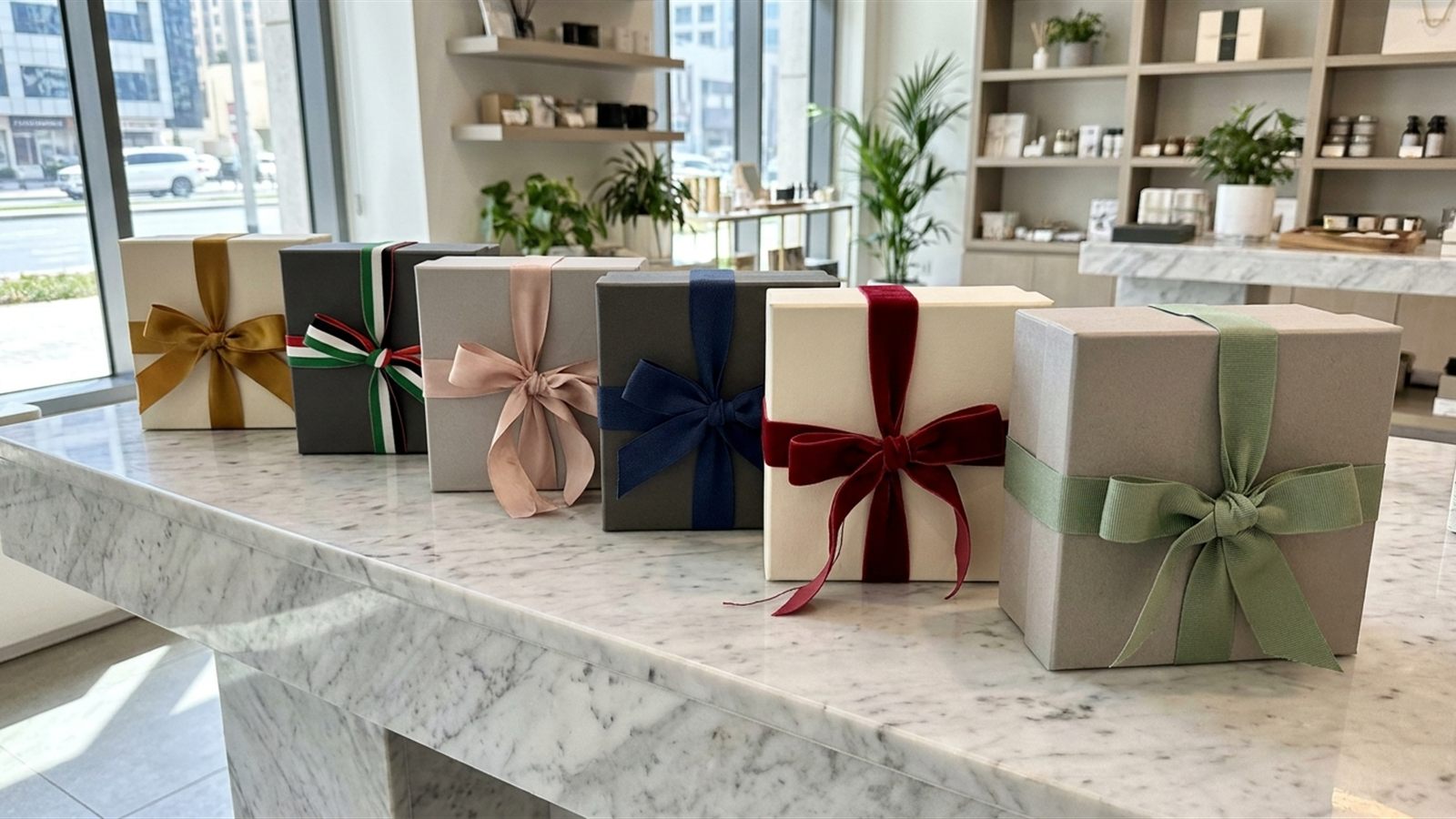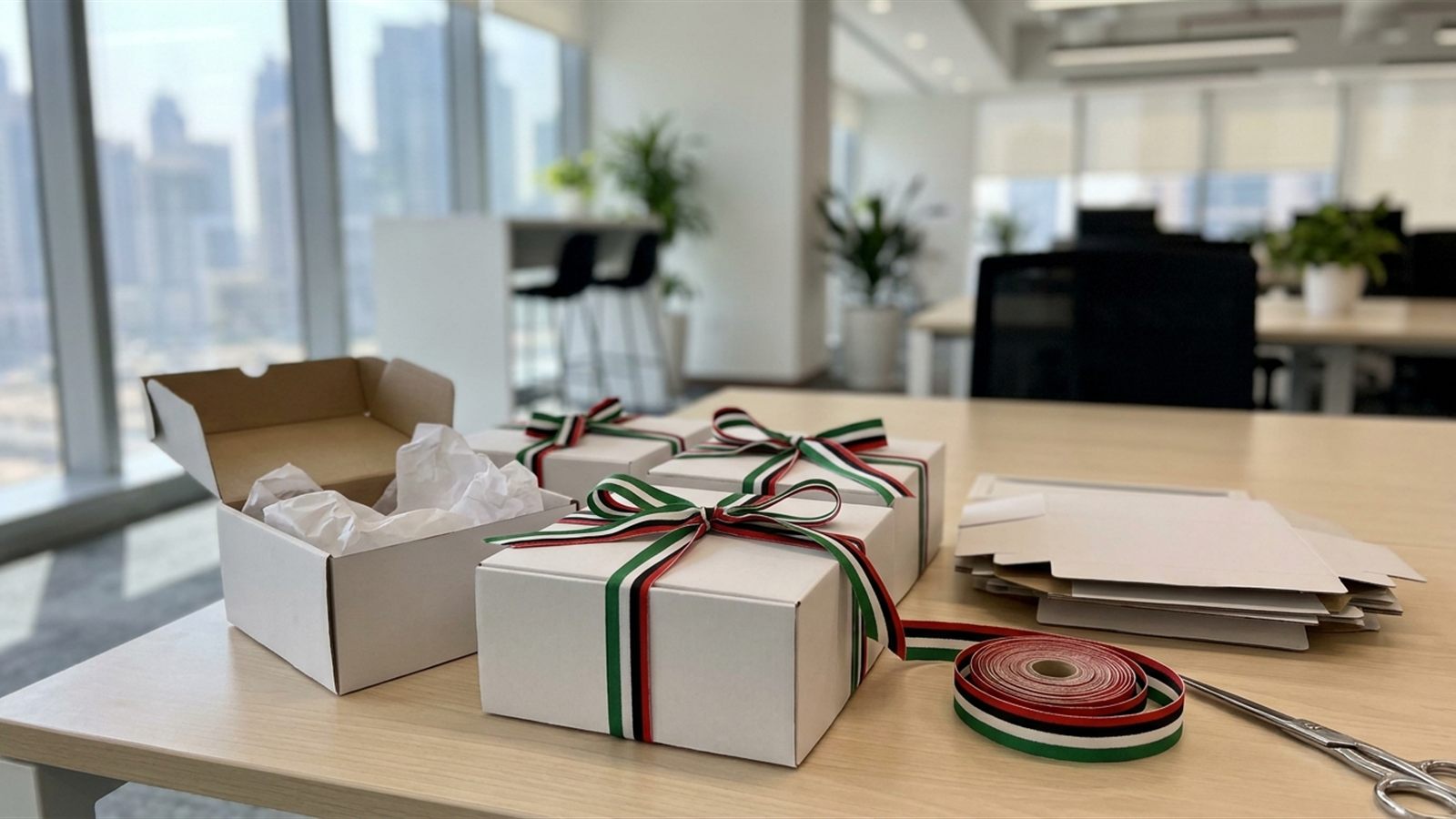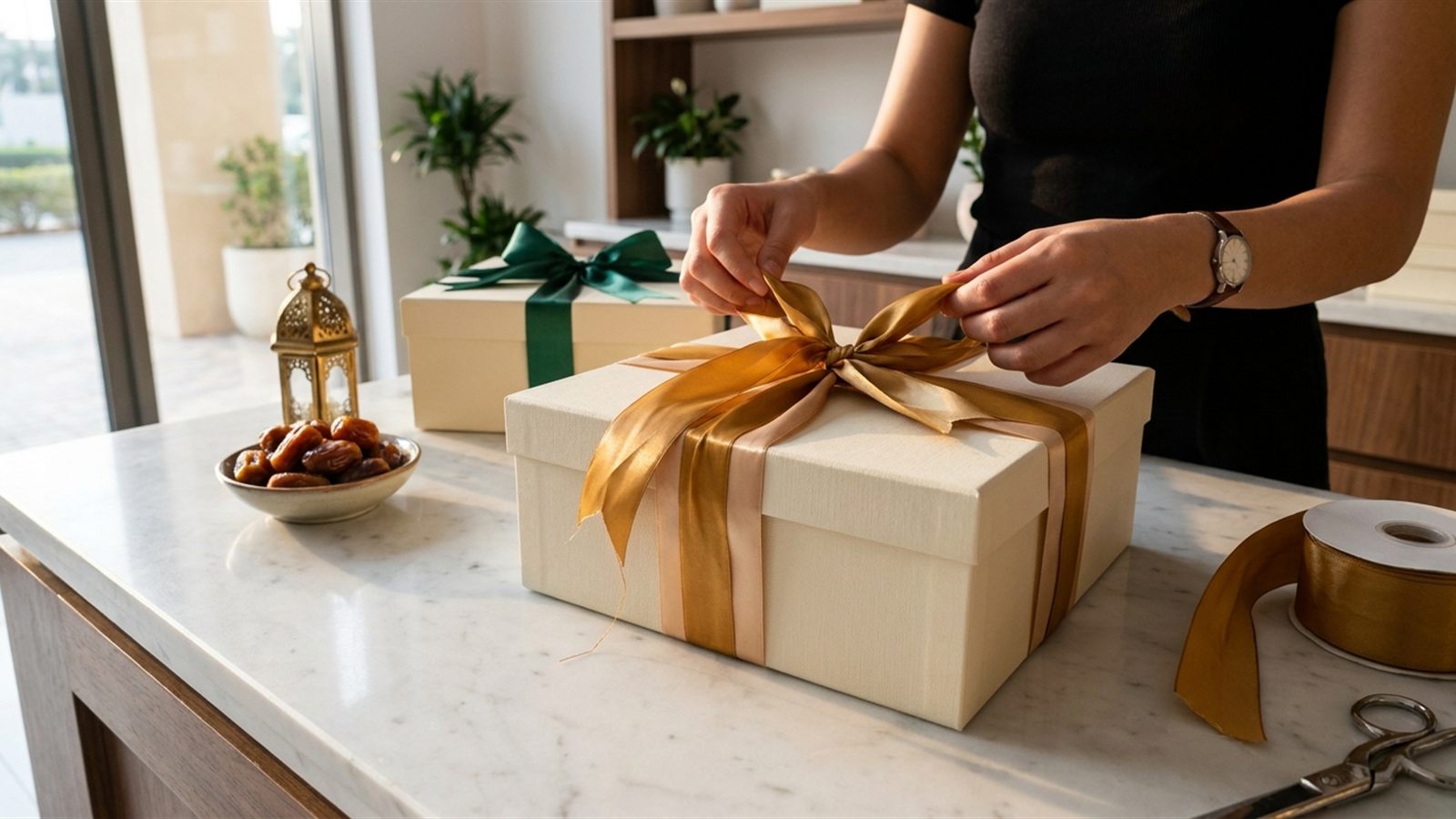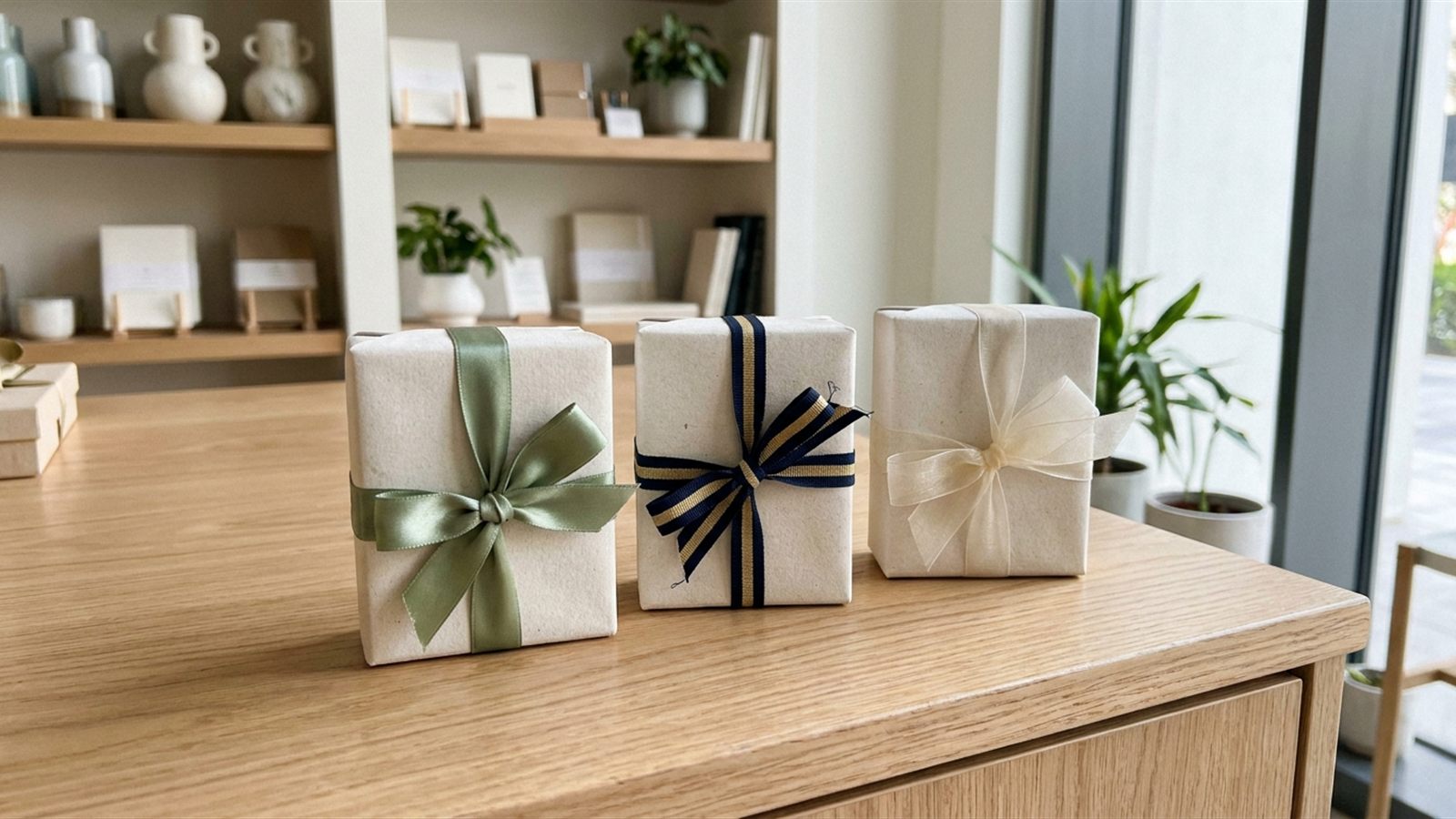
The ribbon is the first thing a client sees
Before a client opens the box, they see the ribbon. For corporate gifts, restraint almost always reads as quality. The aim is a ribbon that makes the gift look like it came from your company, without turning it into an advert.
Start with colour, not the logo
Your brand colour does more work than most teams expect. A clean satin ribbon in the exact shade of your identity is recognised by clients who know you, and it never fights with the box.
If you go this way, the colour has to be right. Name it by its Pantone number, ask for a physical swatch, and judge it in daylight beside the box. The ribbon colour matching guide explains why a photo or a screen cannot be trusted, and why a Pantone number is a close reference rather than an exact promise on fabric.
When a logo earns its place
A printed logo makes sense when the gift goes to people who do not know you yet, when it will be photographed or shared, or when the ribbon is the only branded element on the box.
Sometimes something else does the job better:
- A small woven label sewn into the bow or the tail: a tiny, tactile mark that feels considered.
- A tag on a short loop of ribbon, carrying the logo and a personal line, so the ribbon itself stays plain.
- A sticker on the box or the knot: easy to change between campaigns and good for short runs.
If you do print, the logo-printed ribbon guide covers artwork files, logo height and repeat. Tie a sample bow first and check that one full logo lands on the front.
Ask one question of every branding idea: would the gift look worse without it? If the honest answer is no, leave it off. A quiet ribbon in the right colour is rarely a mistake.
Restraint: one colour, a small repeat, a quiet finish
- One ribbon colour. Two or three colours on one bow start to look like a party, not a boardroom.
- A small logo, repeated with space. Leave a clear margin on both edges and a generous gap between repeats, so the mark sits calmly on the bow.
- A quiet finish. Tone-on-tone or a single foil colour looks understated. Foil gives a refined metallic mark on satin, screen print gives flat solid colour, and digital suits detailed or multi-colour artwork. The guide to foil, screen and digital printing compares them.
Widths for hampers and executive boxes
Use the rule of thumb from the ribbon width guide, based on the shorter side of the lid:
- Up to about 15 cm: 6 to 16 mm.
- About 15 to 30 cm: 16 to 25 mm. A typical executive box sits here.
- Over 30 cm, and hampers: 38 to 50 mm.
Hold two widths across the lid and step back before you commit.
Gift type, ribbon and branding
| Gift type | Ribbon | Branding |
|---|---|---|
| Executive box, around 20 cm | 16 to 25 mm satin in one brand colour | Colour alone, or a small tag |
| Small gift for a large client list | 6 to 16 mm, one colour | Sticker on the box or a sticker on the knot |
| Large hamper | 38 to 50 mm | Colour, plus a woven label or a tag |
| First gift to a new contact | 25 mm satin | Small printed logo with space between repeats |
| Event or conference give-away | Grosgrain, 16 to 25 mm | Printed logo or sticker |
The corporate calendar in the UAE
Corporate gifting in the UAE arrives in waves. Year-end is the broadest, with thank-you gifts to clients and teams. Ramadan and Eid bring hampers and date boxes, covered in the Ramadan and Eid ribbon guide. National Day brings its own red, green, white and black, covered in the National Day ribbon guide. These seasons are also when printers are busiest, so settle your ribbon early.
Bilingual greetings
Many corporate gifts carry a greeting in English and Arabic. On ribbon, keep it short, give each language equal weight, and approve a proof of the final layout before printing. The Arabic text on printed ribbon guide sets out what to check.
Keeping the brand consistent across the year
A client who receives a gift in March and another in December should see the same colour. Ribbon dyed in a later batch can differ very slightly from an earlier one, so read the guide to dye lots and re-orders and plan big seasonal runs with that in mind. The guide to sampling before a bulk order explains how to do that before you commit to a large run.
Quantities
Count your boxes, tie one sample bow, measure how much ribbon it uses, and enter it in the ribbon calculator. Add 5% spare for trimming, mistakes and the odd box that needs re-tying. If you change width, tie and measure a new sample bow first.
Checklist for procurement and marketing teams
- Brand colour named by Pantone number, with a physical swatch approved in daylight
- Decision made: colour alone, label, tag, sticker or printed logo
- One ribbon colour, one finish, one width per gift type
- Sample bow tied on the real box, and logo repeat checked if printing
- Bilingual greeting proofed in its final layout
- Quantity worked out with the calculator, plus 5% spare
- Approved swatch kept on file for later orders
Questions buyers ask
Do I need my logo printed on the ribbon?
No. A ribbon in your exact brand colour often does the work alone, and a small tag, woven label or sticker can carry the logo more neatly. Print the logo when the gift goes to people who do not know you yet.
What width ribbon suits an executive gift box?
A box around 20 cm across suits 16 to 25 mm ribbon. The rule of thumb works from the shorter side of the lid: 6 to 16 mm up to about 15 cm, 16 to 25 mm for about 15 to 30 cm, and 38 to 50 mm over 30 cm.
How do I match ribbon to my brand colour?
Give the Pantone number, ask for a physical swatch and judge it in daylight beside the box, on the finish you will use. A Pantone number is a close reference on fabric, not an exact promise.
Which print finish looks most understated?
A single foil colour on satin, or tone-on-tone printing, usually reads as the quietest. Screen print gives flat solid colour, and digital suits detailed artwork.
How do I keep the colour the same across orders?
Keep an approved physical swatch and check every new batch against it. Ribbon from a later dye batch can differ slightly, so approve a sample before a large run.
How much ribbon should I allow?
Use the ribbon calculator with a measured sample bow, then add 5% spare.